
The Real Reason You Can't Stick to a Language (It's Not Laziness)
You haven't failed at language learning because you lack discipline. The real barrier is psychological - and it's more fixable than you think.

Polyato Team
March 15, 2026
You downloaded the app. You did the first few lessons. Maybe you kept a streak going for a week, even two. Then life happened - a busy day, a missed session, and suddenly the streak was gone and so was your motivation.
Sound familiar?
If you've quit a language-learning app before, you've probably told yourself some version of the same story: I'm just not a language person. I don't have the discipline. Maybe later, when things calm down.
Here's what's actually true: it wasn't laziness. It was the setup. You were given the wrong tool for the wrong reasons, and then blamed yourself when it didn't work.
This post is about what actually makes language learning stick - and why the barrier is less about willpower and more about identity, psychology, and the way learning fits (or doesn't fit) into your day.
TL;DR
- Quitting a language app is almost never about laziness - it's about cognitive switching cost and a tool that lives outside your existing habits.
- The Ebbinghaus forgetting curve erodes progress whenever you miss days, making inconsistency feel like no progress at all.
- Fear of sounding stupid is a real and underrated barrier; practicing with an AI removes the social stakes that cause most learners to avoid speaking.
- Identity matters: lasting change comes from seeing yourself as someone who is becoming a speaker, not just someone who uses an app.
The Forgetting Curve Is Working Against You
In the 1880s, a German psychologist named Hermann Ebbinghaus ran a series of experiments on himself, memorizing hundreds of nonsense syllables and measuring how fast he forgot them. What he found became known as the forgetting curve: without reinforcement, we lose roughly half of new information within a day, and most of the rest within a week.
Over a century later, that curve hasn't changed. And most language apps are quietly fighting a losing battle against it.
The problem isn't that apps don't know about spaced repetition - many of them do, and they use it. The problem is what happens when you miss a day. Or two days. Or a week because you were traveling.
When there's a gap in your practice, the forgetting curve accelerates. The vocabulary you drilled last Tuesday starts to fade. The grammar pattern you almost had solidified starts to slip. And when you open the app again after a break, you're not picking up where you left off - you're quietly rebuilding.
Most learners don't realize this is happening. They just feel like they're not making progress. That feeling, compounded over weeks, is what kills motivation.
The solution isn't longer sessions. It's consistency at low effort - short, frequent contact with the language, even on hard days. That's easier said than done when your learning tool lives in a separate app you have to consciously open.
Why Context-Switching Kills Motivation
Every time you decide to practice a language, you're making a micro-decision. Open the app. Log in (or stay logged in, if you're lucky). Navigate to where you left off. Switch your brain from whatever you were just doing - a work message, a scroll through Instagram, a conversation - into "learning mode."
That transition has a cost. Psychologists call it cognitive switching cost, and it's real. The mental energy required to shift context doesn't sound like much, but it adds up. On a low-energy Tuesday evening, that small friction is often the difference between starting and not starting.
Apps know this. It's why they send push notifications. But a notification telling you to open a different app is still asking you to leave what you're doing and go somewhere else. And the more often you ignore those notifications, the better you get at ignoring them.
Now think about how you use WhatsApp. You're already in it multiple times a day. You don't "context-switch" into WhatsApp - it's woven into your day. When your language tutor lives there, the friction drops to almost nothing. You finish a voice message with a friend and send one to your tutor. You're waiting for a bus and you practice a few sentences. You're already there. The switch has already happened.
That's why WhatsApp is such a natural fit for language learning - it's not a new behavior, it's a new channel for an existing one.
The Identity Gap Nobody Talks About
Here's the deeper issue, the one that apps can't solve with better gamification or prettier design.
Language learning, for most adults, requires you to see yourself as a learner. Not just as someone who downloads apps or completes exercises - but as someone who is becoming someone who speaks another language.
That identity shift is harder than it sounds.
Most adults haven't been students in years. Being a beginner again - especially at something as exposed as language, where you sound childish and get things wrong constantly - triggers a kind of quiet shame. You feel embarrassed at your own fumbling. You compare your broken Spanish to the fluent video on TikTok. You imagine what you'd sound like in a real conversation and it sounds bad, so you put it off.
This is the identity gap: the distance between who you are now (someone who studies a language sometimes, and not very well) and who you want to become (someone who actually speaks it). The wider that gap feels, the easier it is to disengage.
Habit researcher James Clear writes about identity-based habits - the idea that lasting behavior change comes from changing your self-concept, not just your actions. Instead of "I want to learn Spanish," the goal becomes "I am becoming a Spanish speaker." Every small practice session is a vote for that identity.
The problem is that language apps work against this. They make you feel like a student who is failing a course. The streak resets. The exercises get harder. The progress bar barely moves. Your identity as a learner is constantly being tested against a performance metric, and you're usually losing.
The Fear of Judgment Is Real (and Underrated)
There's another psychological barrier that rarely gets named: fear of sounding stupid.
Speaking a new language out loud, in front of another person - even a patient tutor - is genuinely vulnerable. You're an adult who is competent in your professional life, and suddenly you can't form a simple sentence. That dissonance is uncomfortable enough that many learners avoid speaking practice entirely. They read, they listen, they do exercises. But they don't speak.
The result is that people can sometimes pass written tests in a language they couldn't hold a conversation in. The skill they actually need - the one that would let them order food in Lisbon or close a deal in Mexico City - never develops.
Conversational AI changes this in a specific and underrated way: there's no one watching you fail.
When you're practicing with an AI tutor via voice message, you can send a voice message that's completely wrong and the cost is zero judgment. You can ask the same question five times. You can try something awkward and delete it and try again. The AI doesn't remember you as the person who said "yo soy have hunger" last Thursday. Every session is a clean slate wrapped inside a continuous, personalized learning arc.
That safety isn't a small thing. For many learners, it's the first time they feel genuinely free to be bad at something, and that freedom is what finally lets them get better.
The "I'll Do It Later" Trap
One of the most common patterns among people who quit language apps: they move their practice time to later in the day. Then later becomes evening. Evening becomes before bed. Before bed becomes tomorrow morning. Tomorrow morning becomes next week, after things settle down.
This isn't a character flaw. It's how human motivation actually works. The further a task is from the present moment, the more abstract and optional it feels. And optional things get bumped by concrete, immediate demands - the meeting, the message, the thing your kid needs right now.
Habit stacking - attaching your practice to something you already do - helps significantly. But it still requires opening an app that's separate from the thing you already do.
When your language tutor lives in WhatsApp, "later" collapses. You're already there when you're having coffee. You're already there during your commute. You're already there when you're waiting. The tool is present in the moments when you'd naturally use it, rather than sitting in a folder waiting for you to remember it.
What "Low Effort" Practice Actually Builds
There's a myth that serious learning requires serious sessions. Long study blocks, textbooks, flashcard marathons. And while deep study has its place, it's not what builds a lasting skill.
What builds a lasting skill is accumulated contact hours - many small exposures over a long time, consistently reinforced. A ten-minute conversation every day beats a two-hour session once a week, both for retention and for developing the automatic, intuitive feel for a language that marks real fluency.
This is also why conversational practice beats grammar drills for most learners. When you practice grammar in isolation, you learn rules. When you practice in conversation, you learn language - the messy, contextual, real-world version that actually transfers to speaking and listening.
An AI tutor that fits into your existing day, adapts to your level, and gives you a low-pressure space to practice speaking is doing something specific: it's making it easier to accumulate those contact hours without requiring you to reorganize your life to do it.
The Path Forward
If you've quit before, it doesn't mean you're not a language person. It means you were using a tool that made learning feel like a separate, effortful activity rather than a natural part of your day.
The learner identity you're building doesn't require you to be perfect or consistent every single day. It requires that the moments of practice be accessible, low-stakes, and woven close enough to your real life that they happen when you have a spare two minutes - not only when you've scheduled a formal study session.
That's what Polyato is built for. Polly, the AI tutor, lives in WhatsApp - where you already are - across 80+ languages, with no app to download. She meets you at your level from the first message. You can practice via text or voice. You can pick it up and put it down without losing your place or your momentum. Here's exactly what the first week looks like if you want the full picture before starting.
If you've tried before and stopped, that's not a reason to skip this one. It's the exact reason to try it differently.
Start your first lesson on WhatsApp - no app download needed.
Frequently Asked Questions
I've tried language apps before and always quit. Why would this be different? The core difference is where the learning happens. Most apps require you to remember to open them, navigate to your progress, and context-switch into learning mode. When your tutor lives inside WhatsApp, which you're already opening throughout the day, that activation barrier disappears. It's a structural difference, not a motivational one.
How long does it realistically take to make progress? Most learners notice real improvement - being able to form sentences naturally, understanding more than they expect - within a few weeks of consistent daily practice. Fluency is a longer journey, but the early progress is faster than people expect when practice is regular and conversational rather than drill-based.
What if I'm embarrassed about how bad I am at the language? That's one of the reasons conversational AI works well for beginners. There's no one judging your pronunciation or laughing at a grammar mistake. You can be as imperfect as you need to be in order to learn, which is exactly what getting better requires.
Do I need to practice every single day? Daily practice accelerates progress because it works with how memory consolidates. But missing a day doesn't restart your learning - it just means you practice again when you can. The goal is consistency over time, not perfection in any given week.
I don't think I'm a "language person." Can I still learn? The "language person" identity is something you build through practice, not something you're born with. Most people who speak multiple languages didn't find it easy at first - they found a setup that made showing up regularly feel manageable. That's the whole game.
What if I only have a few minutes a day? A few minutes of genuine conversational practice, done consistently, compounds over time. Five to ten minutes a day is enough to make real progress - especially when the practice involves actual conversation rather than passive exercises.
How does Polyato handle the forgetting curve? Polyato uses spaced repetition principles in its conversational approach - vocabulary and structures you've seen before get woven back into new conversations at the right intervals. You're reinforcing what you've learned without doing separate flashcard reviews. It happens inside the conversation.
Ready to start?
Learn any language through WhatsApp
Join thousands of learners building real conversational fluency with Polyato's AI tutor - right in your WhatsApp.
Get Started FreeRelated Articles
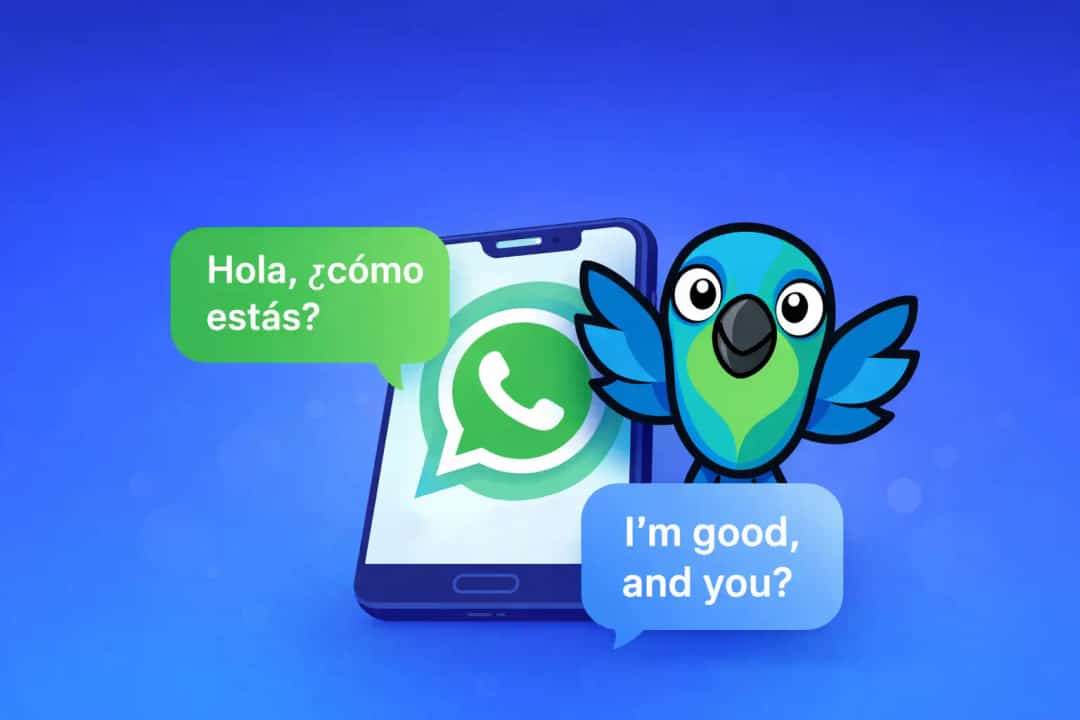
How Polyato Works: Your First Week Learning a Language on WhatsApp
A step-by-step look at what happens when you start learning a language with Polyato - from your first message to your first real conversation.

Why You Can Understand a Language But Still Can't Speak It (And How to Fix That)
You follow podcasts, read articles, understand most of what you hear - so why do you freeze the moment someone asks you to speak? Here's what's actually going on.
5 Tips for Building a Daily Language Practice Habit That Actually Sticks
Consistency beats intensity every time when it comes to language learning. Here are five research-backed strategies to make daily practice effortless - even on your busiest days.