
Why WhatsApp Is the Best Platform for Language Learning
Two billion people use WhatsApp every day. Here's why the world's most popular messaging app is also the most effective environment for language acquisition - and why dedicated language apps keep failing to solve the problem it solves naturally.

Polyato Team
March 5, 2026
When we tell people that Polyato delivers language learning through WhatsApp, the reaction is usually one of two things: "That's brilliant" or "That's... odd."
The skeptics have a fair point. WhatsApp is for messaging friends and family, not studying. But that's exactly why it works.
TL;DR
- Language apps fail because they demand a deliberate context switch every single day; WhatsApp eliminates that by putting practice where you already are.
- Duolingo's day-30 retention is around 30% - the dropout problem isn't about motivation, it's about platform integration.
- The conversational format of WhatsApp trains the exact skill that matters - real-time back-and-forth - rather than isolated drills.
- Async messaging lowers psychological pressure, making learners more willing to attempt things and less likely to quit.
- Ten 3-minute sessions distributed through the day adds up to the same 30 minutes as a single study block, but with better retention.
Why Language Apps Keep Failing
The language learning industry has spent billions testing a hypothesis: that if you make an app friction-free enough and gamified enough, people will stick with it.
The results are in. Duolingo - the most popular language app in the world - has a day-30 retention rate of around 30%. That means 70% of new users are gone within a month. Other apps are worse. The problem isn't that these apps are badly built. The problem is structural.
Language apps live in isolation. They're separate from your life, separate from your actual communication, and separate from the people and contexts where you'd actually use the language. Every day, learners face an implicit question: "Should I open the language app, or do something more immediately relevant?" The language app almost always loses.
The apps that work best long-term are ones with strong intrinsic motivation - learners who are genuinely obsessed. But most people have extrinsic motivation: "I want to talk to family back home" or "I need this for work." Those motivations are real, but they don't activate unless the learning is integrated into actual daily use.
Gamification - streaks, points, achievements - works as a short-term patch. It's a consolation prize for learners who aren't yet experiencing the real reward of language: being able to communicate. The moment something else competes with your streak, the streak loses.
This is why most learners quit - not because they lack discipline, but because the tools they're using work against the way human motivation and habit formation actually function.
The App You Already Use
Here's the insight that most language companies miss: messaging apps are where billions of people already spend a significant portion of their day.
WhatsApp has over 2 billion monthly active users. For people across Latin America, Europe, Africa, and Southeast Asia, it's not one app among many - it's the app. It's where you talk to family. It's how you coordinate with colleagues. It's where you ask your friends what they're doing tonight.
When language learning lives inside WhatsApp, it's not competing with other apps. It's part of the same stream of conversation you're already in. You don't decide to open WhatsApp - you open it automatically, dozens of times a day. If your language tutor is there, you practice. If not, you don't. The behavior becomes automatic in a way that's nearly impossible to replicate with a dedicated app.
This parallels what happened with email marketing: the same content and messaging saw dramatically higher engagement once it landed on mobile platforms people were already using constantly. It wasn't about better writing - it was platform fit. Language apps suffer the inverse problem. They ask people to build a new habit in a new location, rather than plugging into an existing one.
Conversational by Design
WhatsApp is a messaging platform. Its entire interface is optimized for back-and-forth conversation - exactly the skill that language learning is ultimately about.
When you practice with Polyato on WhatsApp, you're not clicking through multiple-choice questions or watching vocabulary videos. You're having a conversation. You type something, get a response, react to it, respond again. The medium itself trains the skill.
This matters more than it might seem. Language fluency is fundamentally a real-time skill. The ability to understand and respond quickly, without consciously translating in your head, only develops through repeated conversational practice. WhatsApp's message-reply format naturally builds this rhythm - in a way that flashcard apps and grammar drills simply don't.
Low Pressure, High Frequency
One of the psychological challenges of language learning is the performance anxiety that comes with formal study. When you're in "learning mode," every mistake feels significant. You're being evaluated. You feel the weight of trying to improve.
Messaging on WhatsApp doesn't feel like that. It feels like chatting. The informal nature of the medium lowers your psychological defenses and makes you more willing to attempt things you're not sure about.
This matters because willingness to attempt is one of the strongest predictors of language learning success. Learners who try, fail, and try again progress steadily. Learners who wait until they're certain before speaking tend to stagnate - often for years. The fear of sounding stupid is an underrated barrier that conversational AI in a low-stakes format genuinely helps to dissolve.
Asynchronous Flexibility
Unlike scheduled tutoring sessions or live conversation exchanges, WhatsApp is fully asynchronous. You can respond when you have a moment - during a work break, waiting in line, on the bus home.
This flexibility matches the reality of modern life. Most people can't block out consistent 30-minute windows for language study. But everyone has pockets of 3–5 minutes scattered throughout the day.
Those pockets add up. Ten 3-minute sessions throughout the day is 30 minutes of practice - the same as a single dedicated session, but distributed in a way that's actually sustainable. And because short, frequent practice compounds faster than infrequent long sessions, distributed practice isn't just more convenient - it's more effective.
More Than Messaging
Polyato's WhatsApp integration goes beyond simple text conversation. Polly, the AI tutor, supports:
- Voice messages - practice pronunciation and get audio feedback in real time
- Image descriptions - share a photo and describe it in your target language
- Writing practice - draft emails, messages, or longer texts and get corrections
- Grammar explanations - ask any question and get a clear, contextual answer
The richness of WhatsApp as a communication medium translates directly into richness as a learning environment. And it all happens inside the same app you're already using every day.
The Result
The best learning tools don't feel like work. They meet you where you are, fit into your existing life, and make improvement feel like a natural byproduct of your day rather than a separate task you must carve out time for.
WhatsApp is where hundreds of millions of people already are. Polyato - with Polly as your AI tutor, 80+ languages available, and no download required - simply makes that time count.
If you're ready to turn your daily messaging habit into a path to fluency, get started with Polyato today. Polly is already waiting.
Ready to start?
Learn any language through WhatsApp
Join thousands of learners building real conversational fluency with Polyato's AI tutor - right in your WhatsApp.
Get Started FreeRelated Articles
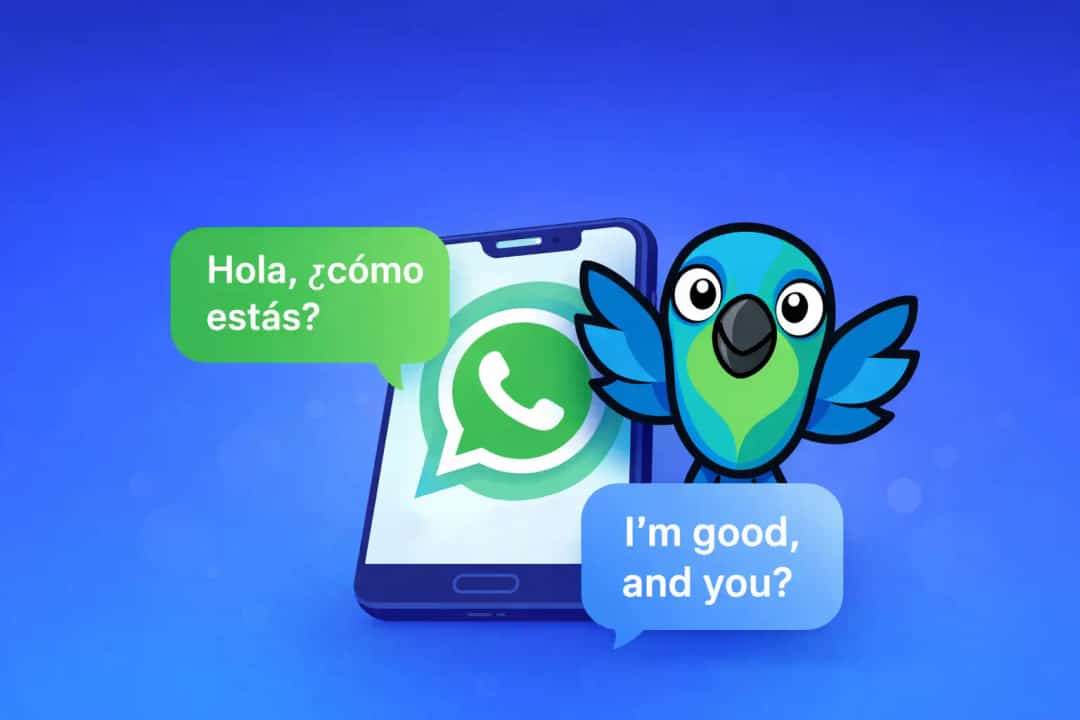
How Polyato Works: Your First Week Learning a Language on WhatsApp
A step-by-step look at what happens when you start learning a language with Polyato - from your first message to your first real conversation.
Why You Can Understand a Language But Still Can't Speak It (And How to Fix That)
You follow podcasts, read articles, understand most of what you hear - so why do you freeze the moment someone asks you to speak? Here's what's actually going on.
The Real Reason You Can't Stick to a Language (It's Not Laziness)
You haven't failed at language learning because you lack discipline. The real barrier is psychological - and it's more fixable than you think.